
Media Research Project

“The primary objective of the ADC-RI Media Research Project is to research, track, and document anti-Arab and Islamophobic bias in the media, public discourse, and from public officials. This tracking project will serve as a resource tool which will highlight the prevalence of bias and bigotry. The project will expose xenophobia and hatred that target minorities in the U.S., particularly Arab and Muslim Americans.
The project will also celebrate achievements of Arabs and Muslims from around the world.”

Search
Generic filters

   Try these: RacismIslamophobiaAnti ArabAnti Islam

Zionists Already Laying the Groundwork for New US-Israeli War

by ADC Team

The American-Israeli war with Iran has no obvious exit ramp — and there’s growing concern that US ground troops will be sent to occupy at least parts of Iran — but Israel’s partisans in DC (and Israelis themselves) are already angling for a new war with … NATO ally Turkey. 

It sounds preposterous, but Israel is no longer bothering with the pretense of being a normal country. October 7 turbocharged what was already a very militaristic country with revanchist ambitions. 

A few weeks back, Israeli opposition leader Naftali Bennet, speaking to a Zionist Jewish American audience, labeled Turkey the “new Iran” to a round of applause. Characterizing the country as “an emerging threat” that seeks to “encircle Israel,” Bennet laid out a vision of alleged Turkish expansionism in the region. More recently, Bennet warned that Turkey might be seeking to surround Israel with “terror,” which he left undefined, and warned that Israel would “not sit idle.” 

Ironically, Bennet accuses Turkey of seeking a “radical Islam Sunni” alliance when it is Israelis like Bennet who harbor deeply expansionist goals, and whose nation is currently occupying Lebanon, Syria, Palestine, and waging war on Iran in a bid for regional hegemony. Moreover, Bennet opposes a Palestinian state as a matter of ideological principle. 

And yet, an Israeli leader, whose Zionism is fueled by his religious orthodoxy, seeks to pretend that it is Turkey, and not Israel, that seeks to dominate the region militarily. In this false narrative, Israel’s posture is portrayed as merely self-defensive. In reality, Bennet is aiming to pursue a self-fulfilling prophecy. Adopting a hostile approach to Turkey will inevitably lead to a Turkish reaction, which Israel will then cite as “proof” that Turkey threatens Israel. 

Israel has done this before. Back in the 1950s, Israel was deeply suspicious of the new Egyptian leader, Gamal Abdel Nasser, even though Nasser’s initial ambitions were to ignore Israel and focus on aggrandizing power and building up an industrial economy. Israel adopted a hostile approach, including staging false-flag attacks on Western targets in Cairo and Alexandria to pin them on the Egyptians and turn Western nations against it. Google the Lavon Affair. 

Israel’s hostile approach did, in fact, turn Nassar not only against Israel but also against the West, which he viewed as tolerant of Israel’s hostility. All of that worked toward Israel’s benefit. 

Everyone should be concerned about history repeating itself, especially since Israel’s influence in Western capitals is significantly more pronounced today than it was back then. Israel’s goal is not merely to confront Turkey alone, something that would be extremely difficult, but to turn the US against its NATO ally. Israel cannot fight a war against Iran without American armor, let alone Turkey. 

So, Zionists are trying to foment opposition to Turkey in the US.

Consider some examples: 

Michael Rubin, a staunch supporter of Israel, is digging up a 2017 incident to call on the Secretary of State Marco Rubio to “recognize Erdogan’s attack on peaceful Americans.” There was no justification for the vulgar tactics of the Turkish president’s team, but as Rubin notes, this is not the first time that visiting authoritarians have behaved thuggishly toward protesting dissidents. Bringing it up nearly a decade later does not seem like a concern over decorum. 

Rubin has also accused Turkey of “Neo-Ottomanism [that] seeks at its core to reverse the national borders that arose from victorious liberation movements in the nineteenth and twentieth centuries.” 

The pro-Israel think tank Foundation for the Defense of Democracies [sic] has characterized Turkey as “Between Ally and Adversary.” FDD’s Executive Director, ​​Jonathan Schanzer, has published an op-ed in the Zionist rag The New York Post, “Beware Turkey’s ambitions in the post-Iran power vacuum.” (Of course, that power vacuum exists ‘cause of the Iran war that he supports.) 

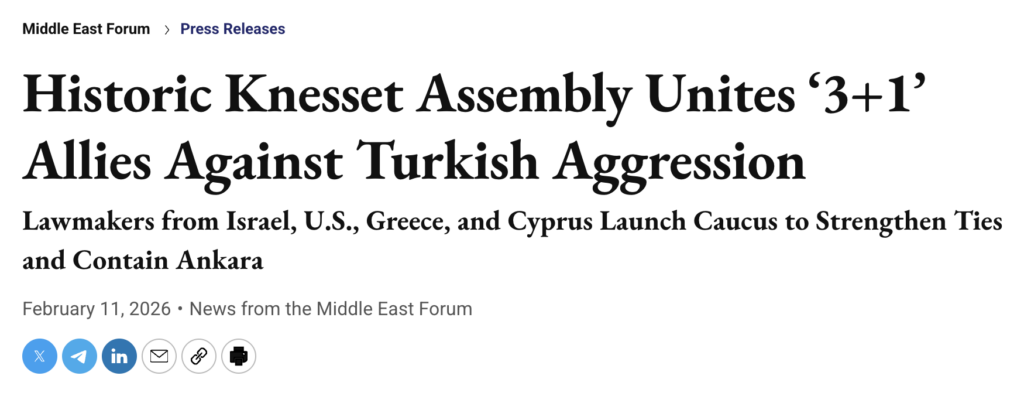
The Middle East Forum, founded by the Islamophobic Daniel Pipes, has touted the Israeli attempt to encircle Turkey via an alliance with Cyprus and Greece (remember Bennet said it was Turkey trying to encircle Israel?) 
The Jewish Institute for National Security of America is similarly starting to beat the narrative that Turkey poses a threat not just to Israel, but to the region. 

This is the height of irony. It is Israel that is trying to sabotage Syria’s rebuilding efforts by sowing divisions between the regime in Damascus and the Druze minority in the south. It is Israel that has advanced into Syrian territory and is enforcing occupation, such as curfews, on local populations. It is Israeli ambitions that seek to keep Syria weak, divided, and vulnerable. 

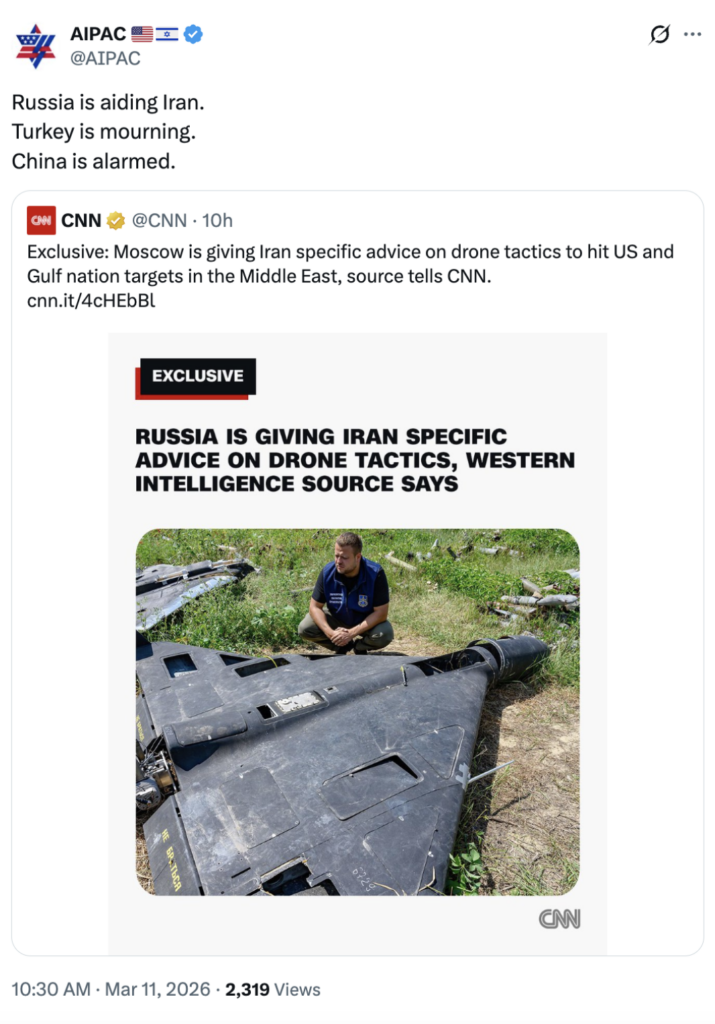
And, lastly, there is the grand lobby of them all: AIPAC, whose X account is increasingly portraying Turkey as an anti-American adversary on par with Russia and China. 

Why does this keep happening? 

It is important to emphasize that while ideology plays a big role here, so does a sense of invincibility. Nations do not solely act out of ideological ambition. What fuels wars of choice and land grabs is the belief that they are reasonably attainable. 

The Israeli-Palestinian conflict is often erroneously described as intractable due to conflicting nationalism: Israelis and Palestinians make, we’re told, irreconcilable land claims rooted in one-sided historical narratives. But nationalist grievances are not uncommon in the world.

The collapse of the Soviet Union led to dueling claims over territory amongst several bordering nations. Lithuanian nationalists, for instance, cited the long-lost Grand Duchy of Lithuania as a basis for contemporary land claims. Polish nationalists did not forget that their country lost 40% of its territory after World War II. Moreover, exiled communities of Germans (relocated from what became Poland after the war) and Poles (exiled from what was ceded to Germany) made claims for land restitution. Central Europe could have easily spiraled out of control, akin to the Balkans. 

Poland’s enlightened government, however, persuaded its neighbors to accept the borders as they currently exist. Three factors lead each nation to abandon its nationalist claims. One, the existence of a balance of power between sovereign states that served to cancel out rival claims. Imposing one’s claims would necessitate war against an actual state with an army, even if it is a weaker state. 

Moreover, the hypocrisy would be too transparent. Poland could not reasonably enforce its claims on Germany without expecting Germany to similarly bring out its own historical claims, to take one example. Lithuania could not demand that Poland cede land heavily populated by Lithuanians unless it was willing to cede its own Polish-majority region to Poland. If any nation wanted its claims validated, it would have to reciprocate. 

Secondly, each nation realized that using history or demographics as a basis for violently changing borders would make it impossible for the nation to be accepted into the very Western institutions — the EU and NATO — they sought to join. Europeans remember that it was such claims that led to World War II, starting with Nazi Germany’s annexation of the Sudetenland, a German-populated region of the erstwhile Czechoslovakia. 

Lastly, there was the fear of their near abroad — Russia — would exploit unresolved border disputes to interfere in Central Europe and play one nation against another for Russia’s own cynical purposes. 

None of these factors is salient in Israel’s relationship with the Palestinians. There is no balance of power between a nuclear-armed, regional superpower and a stateless people. Israel can cite ancient Jewish history to justify land claims without needing to contend with the Palestinians citing modern history to justify, say, the right of return of refugees. 

The Israelis can simply plow ahead knowing that they have the power to enforce their narrative, while the Palestinians exercise no such ability. Israel pocketed the PLO’s recognition of Israel, recognized only the PLO as the representative of Palestinians (but never even the principle of Palestinian statehood), and went on to build more illegal settlements and steal land. A strong nation does not need to reciprocate against a much weaker resistance movement. 

Secondly, while Europeans and the US would have looked askance at a European nation trudging up revisionist claims, they exhibit no such intolerance toward Israeli leaders routinely citing 2,000-year-old archaeology to justify annexing the West Bank. 

There is no difference between Putin’s claim that Ukraine is a fictitious nation and that Russian history justifies the occupation of Ukraine and Israel’s ahistorical claims — but only one is sanctioned. Rather than facing isolation, the more irredentist Israel has become, the closer it has been embraced by the West. 

Lastly, Israelis do not fear their new abroad — Iran — instead, drunk on their own power, they believe they can dictate terms near and far. 

America’s unconditional support for Israel is often cited as a necessary condition for peace: Only a strong Israel, we’re told, would be confident enough to make peace. In reality, US support has fueled the most militarist trends in Israel’s body politic. By funding Israel’s military growth, the US has created a superpower that believes it can act with total impunity. 

Perhaps if the US rescinds its support and compels Israel to bear the full costs of its occupation and reckless policies, the Israeli state may potentially come around to a more restrained approach toward its neighbors. 

You may also like