
Recently, the reliably ultra-Zionist Wall Street Journal editorial page ran a guest op-ed lambasting a candidate for New York state comptroller for his campaign pledge to divest from Israeli bonds, claiming that the (Jewish) candidate would be putting politics over fiduciary responsibility.
It’s an odd charge to make since the state comptroller is an elected public official, an inherently political job, but it’s also hypocritical since the purchase of Israeli bonds has always been political. It is no more political to buy bonds as an act of solidarity with Apartheid Israel than it is to divest as an act of solidarity with occupied Palestinians.
After October 7, 2023, several states did the former. Less than a month after the attack, several state and local governments made a combined $300m in Israeli bond purchases — bringing the total number of Israeli bonds held by them to $1.7 billion by July 2024. Florida led the charge with nearly $150 million in bond purchases, with the state’s chief financial officer, Jimmy Patronis, justifying them in political terms as an investment to “assist our allies in Israel both morally and monetarily.”
The Indiana state treasurer, Daniel Elliott, made a similar argument to justify the state’s purchase of $35 million in Israeli bonds: “Israel is our most important ally in the world.”
“We will stand with them, and we will provide them with the financial liquidity needed to respond to the atrocities we’ve all witnessed,” said Texas’s comptroller in his statement announcing a $20 million bond purchase on October 13, 2023. Pennsylvania’s Treasurer Stacy Garrity similarly foregrounded political motivation in her press release: “Israel is our greatest ally in the Middle East, and I will continue to stand by them in their fight to achieve peace.” While many of these state officials claimed that Israeli bonds were a sound investment, there is no denying that these were political decisions first and foremost, as their own words of support for Israel bear witness.
It was ironic, given that many of these state officials who rushed to buy Israeli bonds made a point just a few years before to attack what they perceived as politicized investments. Several of these state officials, in fact, belong to the right-wing State Financial Officers Foundation (SFOF) — which, certainly not incidentally, counts, at least in the recent past, Israel Bonds as a “bronze sponsor.”
SFOF condemned what is called “woke” investments after the 2020 BLM summer, when some states invested in “racial equity” funds set up by major financial institutions. Opponents argued that such investments might undermine the fiduciary responsibility of states to maximize returns rather than prioritize racial amends.
In light of many of these officials’ rushing to support Israel — but not their fellow historically marginalized Americans — after October 7, the hypocrisy is quite glaring. It is also beside the point. State funds, as noted, are managed by elected officials who are not immune to political considerations, especially human rights causes.
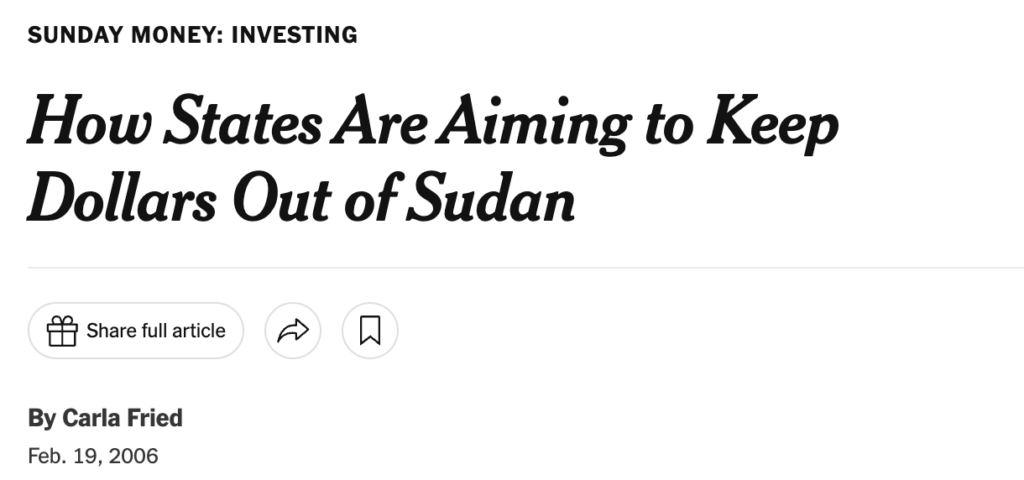
Back in the late 2000s, many states — including New York state — divested from companies investing in Sudan.
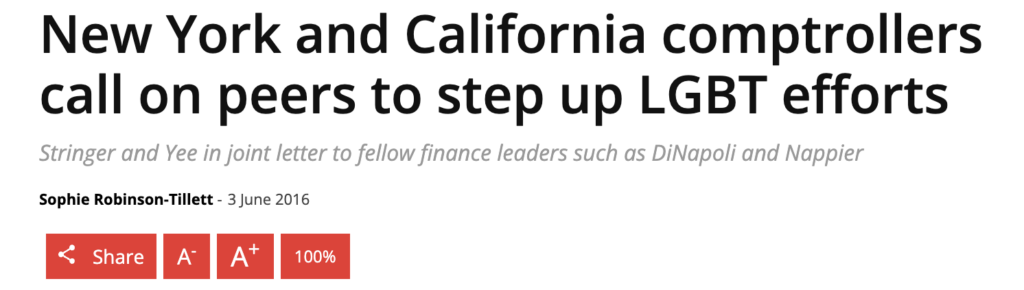
A decade ago, New York State and California used their financial clout to champion LGBTQ+ rights.
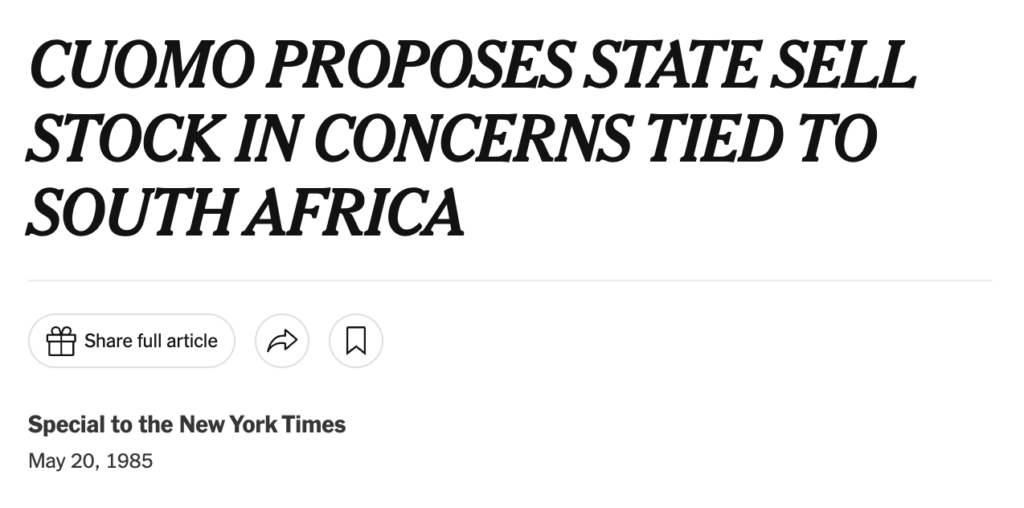
Moreover, the Israel divestment movement — BDS — is based on the movement that targeted Apartheid South Africa, including getting states to divest from the erstwhile regime.