
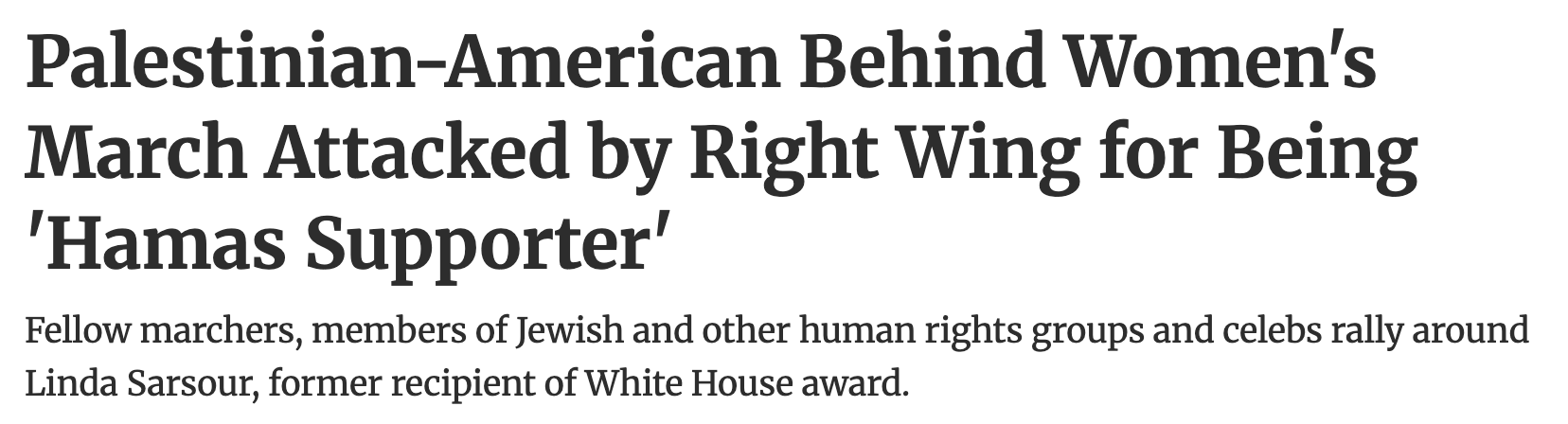
Back in the Resistance winter of 2017, at the advent of the first Trump term, an Arab-American activist from New York City and March co-chair, Linda Sarsour, spoke at the Women’s March in Washington, DC. Sarsour was suddenly the rare high-profile American Muslim, whose salient presence at the March was fitting given that the newly inaugurated president ran on banning all Muslims from the United States.
“I stand here before you, unapologetically Muslim-American, unapologetically Palestinian-American,” Sarsour announced at the head of her speech. “You can count on me, your Palestinian Muslim sister,” she subsequently added. Later on, she mentioned her Palestinian “grandmother who lives in occupied territories.”
By referencing her Palestinianness, Sarsour broke a taboo. She disrupted the safe liberalism of Resistance politics, the kind that seeks to sweep under the rug such inconveniences as Palestinian human rights, and the just-departed Obama administration was no less guilty of harm than the incoming Trump administration was likely to be. Establishment liberalism prefers that its oppositional politics adhere to certain conventions, of which the mythology of Israel is a pillar. Sarsour would have been fine as a token Muslim on stage, but to break conventions made her a pariah in the eyes of many. Within days (see above headline from Ha’aretz), she was attacked as a Hamas supporter.
For sure, many, if not most, of the attacks on Sarsour came from right-wing forces, but it is important to note that so much of it came from mainstream outlets and voices.
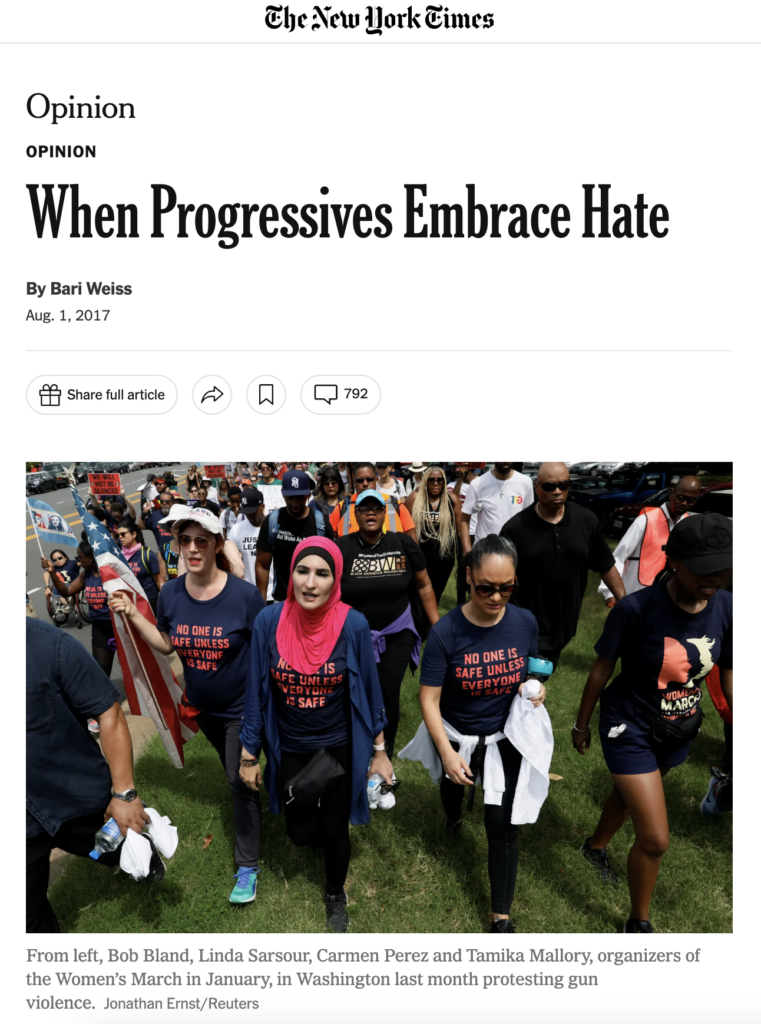
Bari Weiss, then newly appointed at the New York Times, wrote a hit piece against Sarsour, and when Sarsour was scheduled to give a commencement address at City University of New York in late spring 2017, there were calls to rescind the invitation.
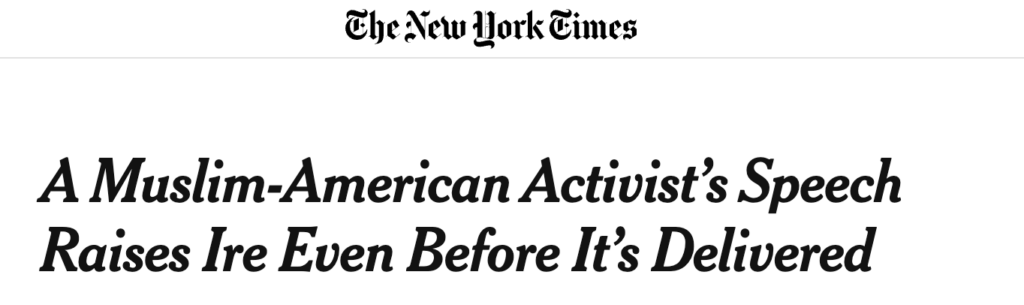
The attacks on Sarsour have never abated. We were reminded of them as we witnessed the onslaught against Hasan Pikar. Here is another charismatic, high-profile American Muslim advocate who is being targeted incessantly for one reason and one reason only: His opposition to Israel and support for Palestinians. Whatever else may be attributed to Pikar, it is Israel that’s animating the attacks against him in an effort to marginalize him. Pikar, like Sarsour, is not an establishment figure or spokesperson for the Democratic Party. They are a media personality or a local activist. In other words, if you don’t like them, you do not have to worry about them having too much influence. But when it comes to American Muslims, there is an obsession with keeping them on the margins, even when the views they express are no different than those expressed by others.
There is no question that these campaigns are led primarily by Zionists determined to prevent Arab-Americans and Muslim-Americans from being a force in politics that could act on behalf of the Palestinians. The ADL, in particular, is worried about the growing political clout of American Muslims due solely to politics around Israel. It is why the ADL decided to kick Muslims while they were down during the Ground Zero Mosque controversy in 2010 by coming out against the project.
It is very telling that Zionists make it their business to aggressively police Black and brown women differently than white women. A pattern is even more noticeable when it comes to Muslims. As the New York Times reported a few years back,
In the 2018 election, the Jewish Democratic Council of America officially rebuked only three Democratic candidates, all of them minorities: Alexandria Ocasio-Cortez (for calling Israel’s killing of unarmed protesters in Gaza a “massacre” and for her affiliation with the B.D.S.-supporting Democratic Socialists of America); Rashida Tlaib (for suggesting she would support cutting military aid to Israel if elected); and Ilhan Omar (for tweeting in 2012 that Israel “hypnotized the world” and calling it an apartheid state). When McCollum, the Democratic white congresswoman from Minnesota, during the same campaign cycle, used the word “massacre” to describe Israel’s killing of scores of unarmed civilians in Gaza, and said Israel was advancing apartheid within its pre-1967 boundaries and replacing democratic values with “bigotry, racism and segregation,” the chairman of the J.D.C.A. board, Ron Klein, told a reporter that McCollum’s statement about apartheid was “inflammatory and wrong,” but the group issued no formal condemnation. Joel Rubin says he was uncomfortable with the positions taken by the group: “The last thing I want is Jewish liberal organizations to be publicly chastising young, progressive brown women, and that’s what happened. It’s very problematic. Those women are the future.”
