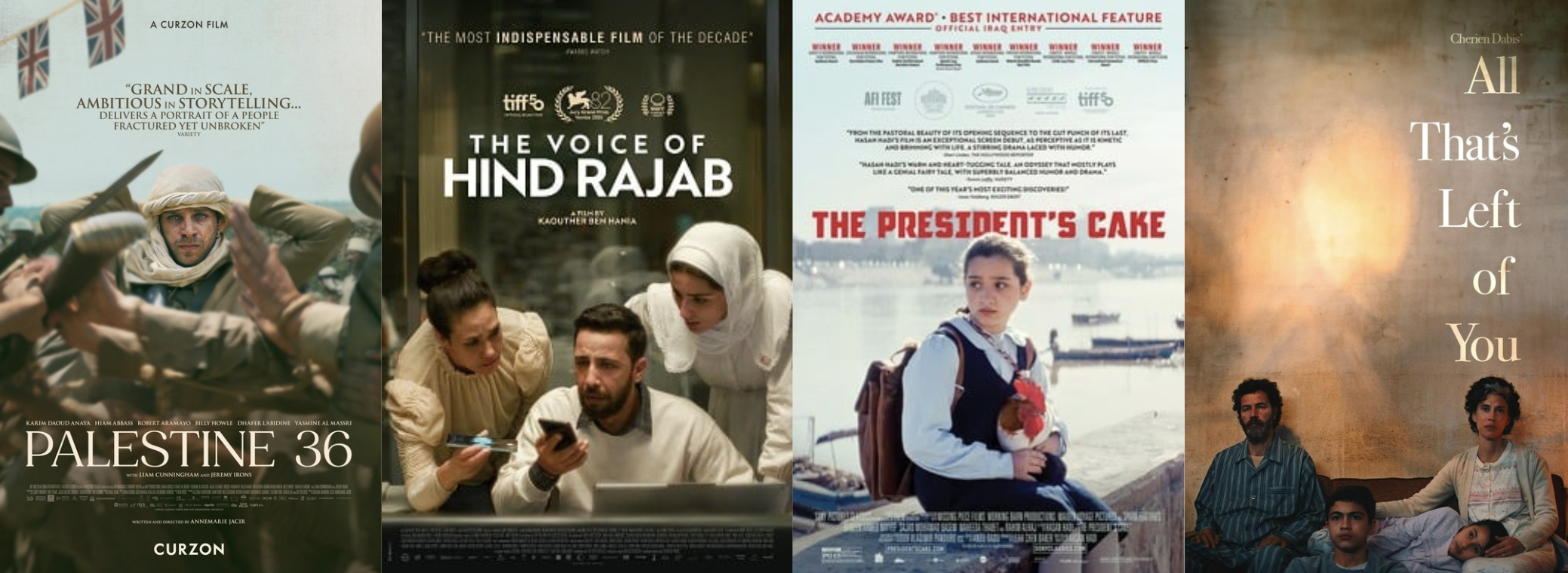
Arab cinema is booming, and recognition of our stories is growing. Recently, four Arab films were shortlisted for an Academy Award in the Best International Feature category.
The films represent the official selections submitted by Tunisia, Palestine, Jordan, and Iraq. Three of the films are on Palestine, all of which are directed by women, two of whom are directed by Arab-Americans Annemarie Jacir and Cherien Dabis, who is also a co-star in her feature.
Two of the films are being distributed by Watermelon Pictures, which is an Arab American-owned production company.
“The Voice of Hind Rajab,” Tunisia
Directed by Tunisian Kaouther Ben Hania, who has already been nominated for two Oscars, this powerful drama is about the five-year-old Hind Rajab, who was killed by Israeli soldiers alongside her family in their car as they sought refuge. Rajab was the sole survivor, who called the Palestinian emergency service to save her life. On the phone for 70 minutes, the ambulance waited until it could receive clearance from Israel, only for Israeli soldiers to shell the ambulance when it neared. Rajab lived for an hour more after the ambulance’s entire crew was killed. But no second crew could risk coming.
The film has opened in Los Angeles and New York, but additional cities may not be forthcoming as several Hollywood distributors backed out of promoting the film due to anti-Palestinian bias.
What the critics are saying:
 Why The Voice of Hind Rajab Will Break Your Heart, Ahmed Moor, The Nation
I remember first seeing the posts on Twitter. A little girl in Gaza was trapped in a car. The audio recordings of her cries and pleas, posted for all the world to listen to: This couldn’t be real, could it? The shock of listening to a child explain that her family was dead and she was scared. Night was falling.
It was too much. As it turned out, the reality was worse than I could imagine it would be.
The Voice of Hind Rajab, Marya E. Gates, RogerEbert.com
Hind’s life ended in martyrdom, and “The Voice of Hind Rajab” exists not just as a clarion call to say never again, it also asks you to sit with this violence. Not with the bloodshed, not with the abstraction of a number in a news article. But with this violence. The physical, mental, and administrative violence that was inflicted on this young girl, who, like so many of her peers, should still be here today.
‘The Voice of Hind Rajab’ re-creates a rescue mission with the real pleas of a terrified girl, Robert Abele, Los Angeles Times
This dramatized movie, however, seeks to retrieve something else: a spark of unignorable humanity from a media ecosystem of headlines and statistics that doesn’t always grasp how distancing it can be.
“All That’s Left of You,” Jordan
Cherien Dabis is no stranger to Palestinian dramas. The filmmaker and actor is behind “Amreeka,” about a Palestinian mother and son who move from occupied Bethlehem to Ohio to live with their Arab-American relatives, and plenty of other films, such as “Villa Touma,” set around three Ramallah-based sisters living as shut-ins. Her latest production, distributed by Watermelon Pictures, is a multigenerational drama chronicling a Palestinian family’s travails.
What the critics are saying:
 All That’s Left of You review – deeply moving epic of Palestinian intergenerational trauma, Adrian Horton, The Guardian
There’s weighty, evocative pathos, but also a blunt sense of utility – film being used as an educational medium, dramatizing monumental tragedy for audiences perhaps not familiar, especially not cinematically, with the Nakba, the British mandate or the massacre at Deir Yassin, reports of which frighten Sharif’s young son Salim.
But as the years go by and the trauma festers, the film grows into something thornier, surprising, beautifully textured and deeply moving.
‘All That’s Left of You’ Review: Cherien Dabis’ Drama Poignantly Traces Decades of Palestinian Displacement, Lovia Gyarkye, The Hollywood Reporter
It’s a moving and intimate narrative about the toll displacement takes on generations of people. How does expulsion dehumanize and what kinds of lives can be shaped in spite of chronic itineracy?
Dabis’ film is particularly moving when focused on the emotional weight of seemingly minor moments: Sharif standing in the orange grove, his children excitedly reciting Arabic verses at dinner, or the tearful separation as they drive away from the house.
“Palestine 36,” Palestine
Palestine’s official Oscar submission, “Palestine 36,” is about the start of the 1936 Arab Revolt against British colonial rule and Zionism’s colonial-settler efforts to displace Palestinians. Directed by Palestinian-American Annemarie Jacir (“Salt of the Sea,” “When I See You”), the film’s focus is on the pivotal moment that many historians consider the turning point in Zionism’s eventual success in conquering the land, as the violent British represson (including arming and training Zionists to aid its efforts) ended up shifting the balance of power between the native Arabs and settler Jews.
What the critics are saying:
Palestine’s Oscar Submission Is a Handsome Historical Drama Charged With Of-the-Moment Resonance, Sheri Linden, The Hollywood Reporter
Like any historical drama, it has a point of view and doesn’t explore every facet of the events it depicts. But neither does it pretend to do so. And even as Jacir maintains an affecting Palestinian perspective, her movie offers far more facets and nuances than, say, Exodus, Hollywood’s star-studded paean to Zionism.
The Country’s Epic Oscar Submission Offers a Sweeping View of a Tumultuous Time, Murtada Elfadl, Variety
It’s grand in scale, ambitious in storytelling and balanced in the way it pays equal attention to historical scope and detailed characterization. The film, which is Palestine’s entry to the Oscars, has a lot of story to tell, but still manages to singularly draw its many characters and to give specificity to its different locations. It demands the audience’s undivided attention and earns it by the end of its running time.
“The President’s Cake,” Iraq
Set in the 1990s, when Iraq was under crippling sanctions that devastated ordinary people, the film tracks a schoolgirl’s attempts to procure ingredients to make a cake, reflecting how the collective punishment of ordinary Iraqis impacted their lives. The film is written and directed by Hasan Hadi and marks his first full feature film. Definitely one to watch.
What the critics are saying:

Hasan Hadi’s Warm and Heart-Tugging Tale Sends Dutiful Kids on an Odyssey in Saddam Hussein’s Iraq, Tomris Laffly, Variety
While “The President’s Cake” mostly plays like a genial fairy tale, with superbly balanced humor and drama, Hadi still unsparing about the ills of patriarchal society.
What packs a punch in “The President’s Cake” is the film’s relatively uneventful ending. The kids might get their cake and return to relative safety in the conclusion. But Lamia and Saeed’s future doesn’t come with any colorful icing on top.
Hasan Hadi’s Poignant Realist Fable Follows Two Schoolchildren Under Saddam Hussein’s Regime, IndieWire, Ritesh Mehta
Iraqi filmmaker Hasan Hadi opens his debut feature, “The President’s Cake,” with a clairvoyant line from Gilgamesh, as the camera sails across a balmy dusk on the ancient marshland waterways of southern Iraq. A poignant realist fable developed at the Sundance Feature Film Program, the recipient of multiple fellowships and grants, and executive produced by Marielle Heller and Eric Roth, the character-focused film dispels in many ways pervasive stereotypes associated with the Middle Eastern nation.
Honorably Mentions
There are a few non-Arab submissions worth considering, too.
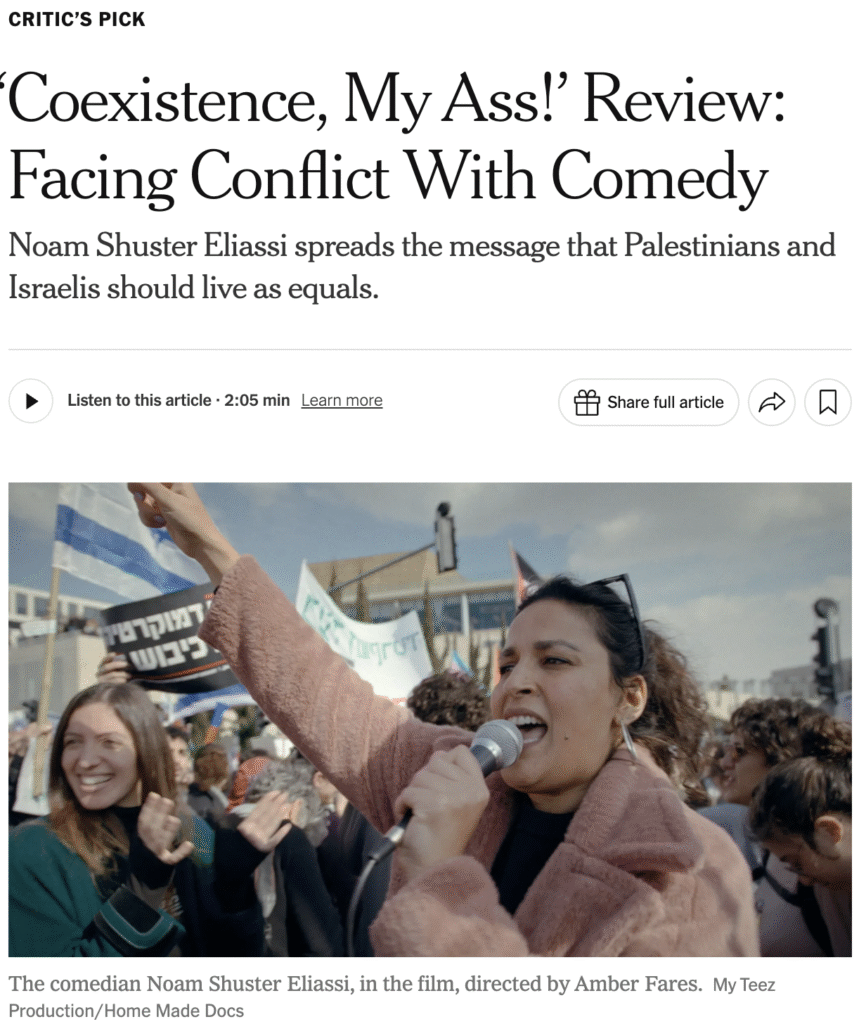
First, shortlisted in the best documentary category, is “Coexistence, My Ass!” by Israeli comedian Noam Shuster-Eliassi, who is a strong advocate for Palestinian rights.