
The key thing to understand about the American legacy media is that their editorial independence when it comes to foreign coverage is practically nonexistent, unlike domestic coverage, where they do not toe the American government’s line.
But when it comes to foreign news, the mainstream media takes its labels, cues, and parameters from the ruling class’s handbook. Human rights coverage, in particular, is either emphasized or downplayed depending on the foreign nation’s friendliness or hostility toward the U.S. So Iran’s (an antagonist) human rights record has traditionally gotten more scrutiny than Saudi Arabia’s (an ally), despite the latter’s equally repressive nature.
Of course, one of the most glaring examples of this bias is the mainstream media’s kid-glove approach to Israel. It is hard to imagine that if Israel were a non-U.S. aligned ethnonationalist state that openly defied the liberal democracy concept of “a state for all its citizens” — Israel rejects this norm and self-defines exclusively as the nation-state of the Jewish people, casting aside its 21% Palestinian minority as de jure second-class — that the American media would present it as a liberal democracy nonetheless. Especially if that country was running the longest military occupation in modern times, and an apartheid state at that.
We recently got to thinking about this double standard as we surveyed the Times’ coverage of Iran’s protest movement and the brutal state crackdown on demonstrators.
The Times’ reporting is candid about the regime’s bare-knuckled approach, including using live ammunition against civilians. The reporting centers the voices of ordinary Iranians as good journalism should do: Do not center power, but uplift those who challenge power.
And the Times takes on good faith the claims of the Iranian opposition, even when it cannot independently verify them, and, conversely, treats with skepticism the claims of the regime.
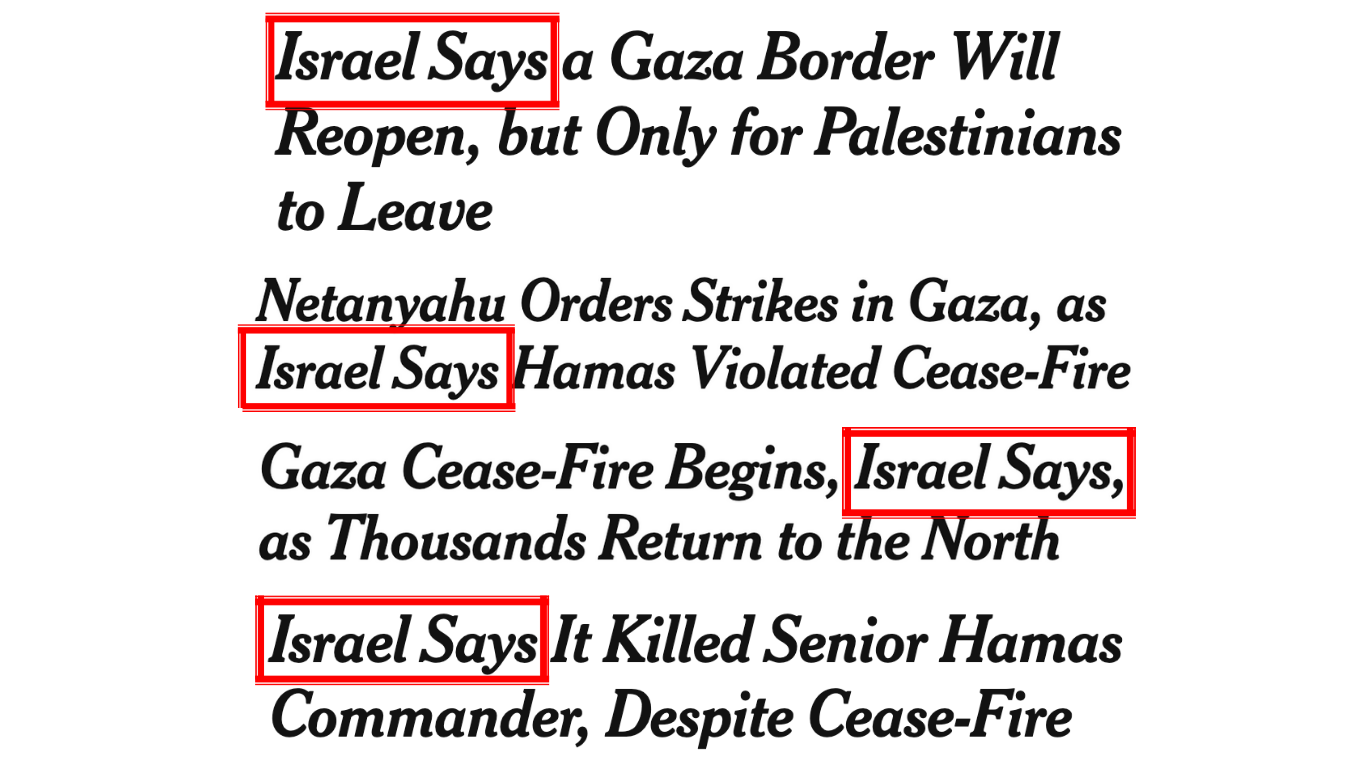
This is the exact opposite of the Times’ approach to Israel and the Palestinians. Israel, above all, is the protagonist that gets the last, middle, and final say. In fact, “Israel Says” is a common Times headline.
The Palestinians are relegated to a secondary role, often appearing in their own voices several paragraphs down in an article, if at all. Moreover, the Times fails to relate the nature of Israeli brutality against Palestinian civilians adequately. Lastly, the Times often does not second-guess Israeli government claims while emphasizing that Palestinian claims cannot be taken at face value.
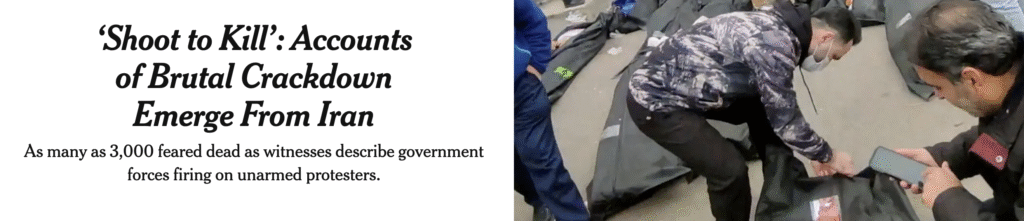
To illustrate the double-standard, consider the example:
In the above Jan. 13, 2026, article, nowhere does the Times mention in a lengthy report that some Iranian demonstrators are armed — despite mentioning near the bottom of the article that “135 members of the government and military [were] killed,” which suggests that some Iranians are using violence to resist their own government.
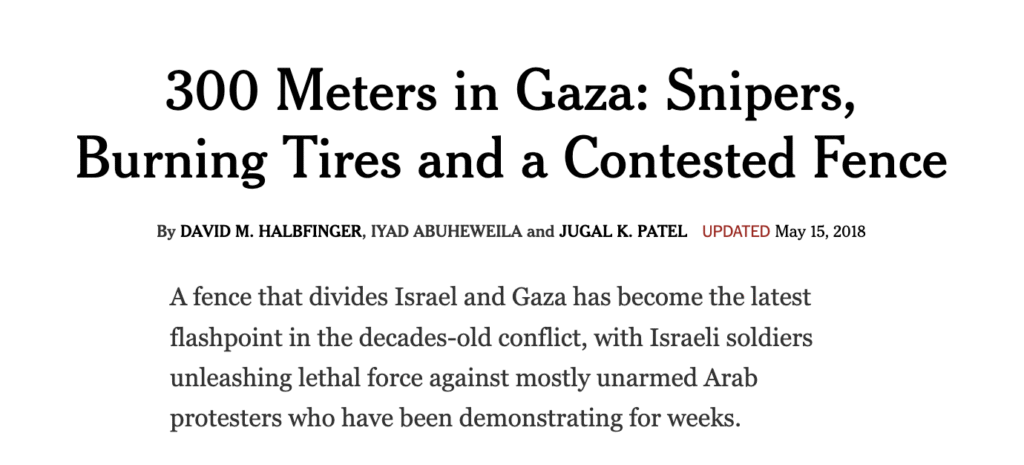
In contrast, during the 2018 Gaza March of Return, when Israel killed 223 Palestinians, the Times mentions in the first paragraph that some Palestinians were reportedly armed.
In there lies a justification of Israeli violence (See? Some of the Palestinians were armed terrorists. Israel was engaged in self-defense.), a downplaying of the asymmetry of violence, and an insistence on perfect victimhood for Palestinians.
If Palestinian protests against Israeli occupation killed 135 Israeli officials and soldiers, it is unimaginable that the Times would fail to mention that fact at or near the top of the story, and the fact that some Palestinians were clearly armed. The different standards on Iran reflect editorial judgement — fortunately for Iranians, their regime is not a U.S. ally.
Moreover, during the March of Return, the Times ran not one but two guest op-eds by Israeli right-wingers Shmuel Rosner and Matti Friedman offering a full-throated defense of Israel’s violence against Palestinians marching toward the Gaza border.
(In no way are we judging Iranians for fighting back against their murderous regime, which is the root of all violence. Just as Israel’s violence is the root of all violence in Palestine. We are simply noting that the Times avoids emphasizing Iranian retaliatory violence while consistently framing Palestinian retaliatory violence as if it is on par with Israel’s far-greater violence or, even worse, the provocation for Israel’s attacks, which is nonsensical and mendacious since an occupying power is interminably engaged in violence.) 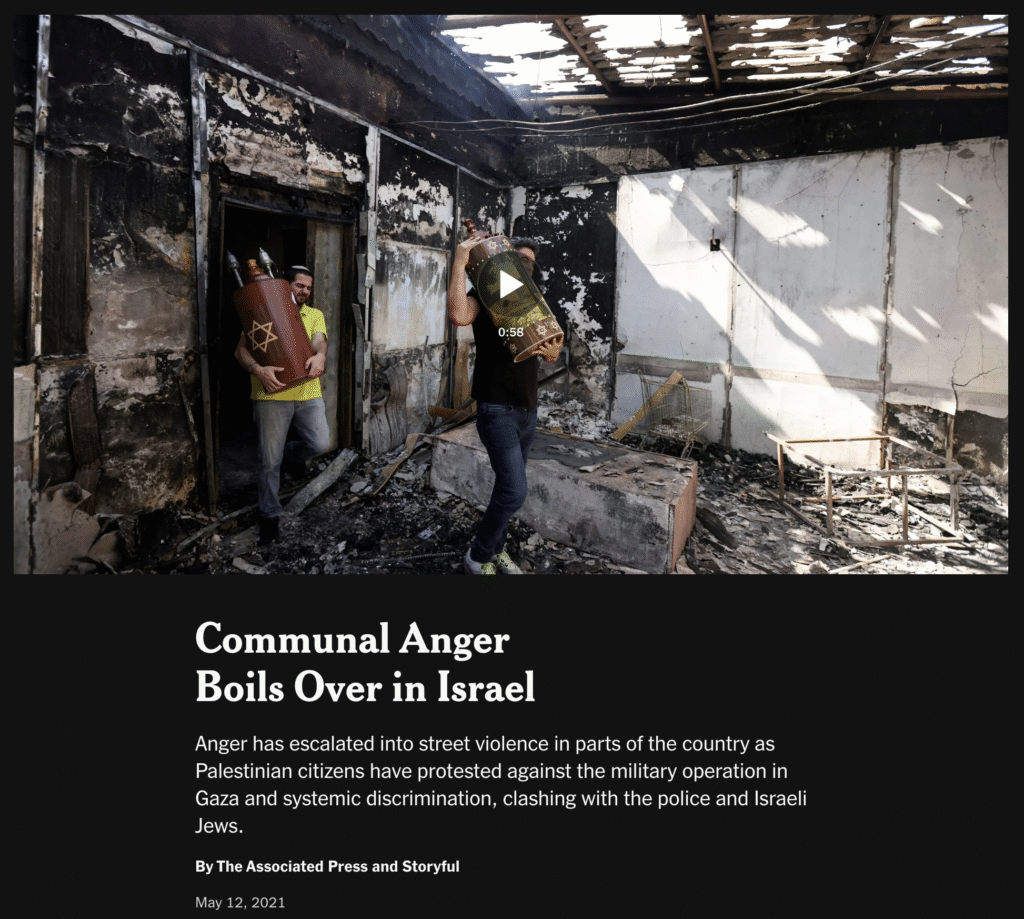 When it comes to the Palestinians, the Times rarely centers the violence against them but consistently centers the violence committed by them.
Consider the 2021 communal violence that erupted inside Israel against the backdrop of another war in Gaza and ethnic cleansing attempts against Palestinians in occupied East Jerusalem.
The Times notes “street violence” in contrast to the “military operation in Gaza,” and the photo shows Israeli Jews clearing out a synagogue. Also, the final line states that Palestinians clashed with Israeli Jews as if it were one-sided when far-right Israeli Jews organized their own vigilante groups that attacked and killed one Palestinian (two Israeli Jews were also killed in the violence).
Two days later (Jan. 14, 2021), the Times had another article on both the war and the Jewish-Arab violence in Israel. That day was uniquely violent for the Palestinians on the West Bank, as noted by an Israeli human rights group:
14 May 2021 was the deadliest day in the West Bank since 2002: 13 Palestinians were killed (two died of their wounds in the following days). Among them were Nidal Safadi, ‘Awad Harb and Isma’il Tubasi – all three killed by armed settlers or by soldiers escorting them during incursions into their villages’ land. [Emphasis mine]
But in the Times report that day, you have to wait until paragraph 21 to read:
At least 11 Palestinians in the West Bank died in clashes with Israeli security forces and more than 200 were injured, the Palestinian Health Ministry said, mostly from live rounds, including around 20 in serious condition. Witnesses said rubber bullets, tear gas and sound grenades were also used.
In interviews, Palestinian witnesses said some of the clashes had been provoked by settlers who burned Palestinian fields and businesses near Nablus, Bethlehem and Hebron. In other areas, protesters were taking part in planned demonstrations against the police raids on Al Aqsa.
At a hospital in Ramallah where his critically wounded brother was undergoing surgery to remove bullets fired by Israeli security forces, Mohammad Amira, 28, a factory worker from the village of Ni’lin, said he and other Ni’lin residents had emerged from Friday prayers at the local mosque at 1:30 p.m. to find that a group of about 25 Israeli settlers had set fire to a greengrocer and a butcher shop.
“‘Death to Arabs,’” they shouted in Arabic and Hebrew, Mr. Amira and other Ni’lin residents said, as they threw stones at villagers’ cars. “‘We don’t want you living next to us.’”
When the Palestinians moved to confront the settlers, they said, seven Israeli soldiers staffing the checkpoint at the entrance to the village started spraying tear-gas and shooting live ammunition. They were later joined by backup, the residents said, and clashes continued Friday night.
