Hen Mazzig is an Israeli influencer who has never borne witness to the death of a single Palestinian child, but these days he has been posting tributes to Iranian civilians killed by their government during the recent brutal and deadly crackdown on anti-regime protesters.
In one such post, he wrote, “When you gun down teenagers for demanding dignity, you don’t maintain order. You prove your authority rests on bullets, not consent.”
Hen would be hard-pressed ever to acknowledge that the Israeli occupation forces he served in routinely kill Palestinian teenagers and that Israel’s rule in the West Bank rests on brute force, not democratic consent. But he represents a trend amongst Zionists.
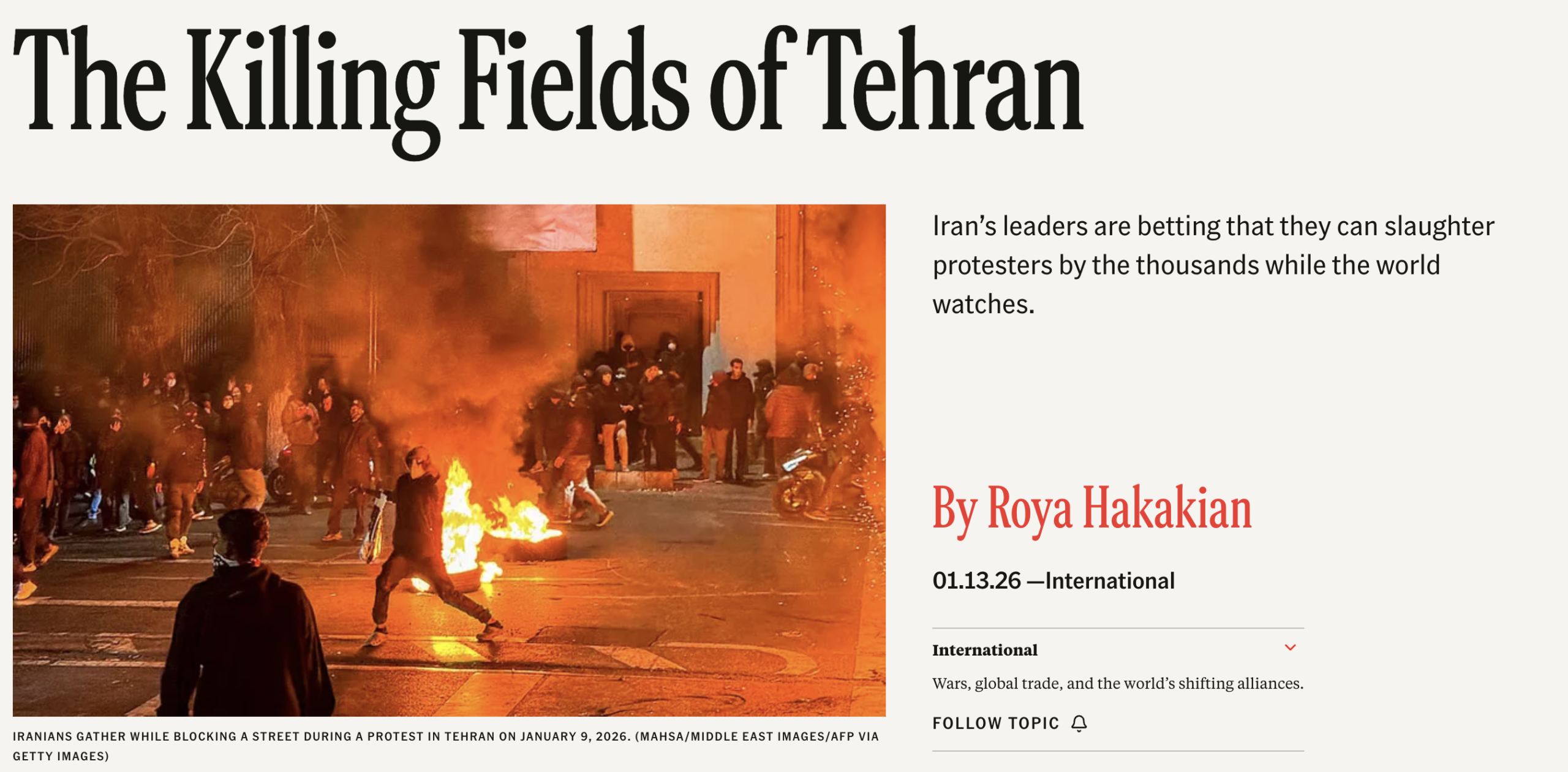
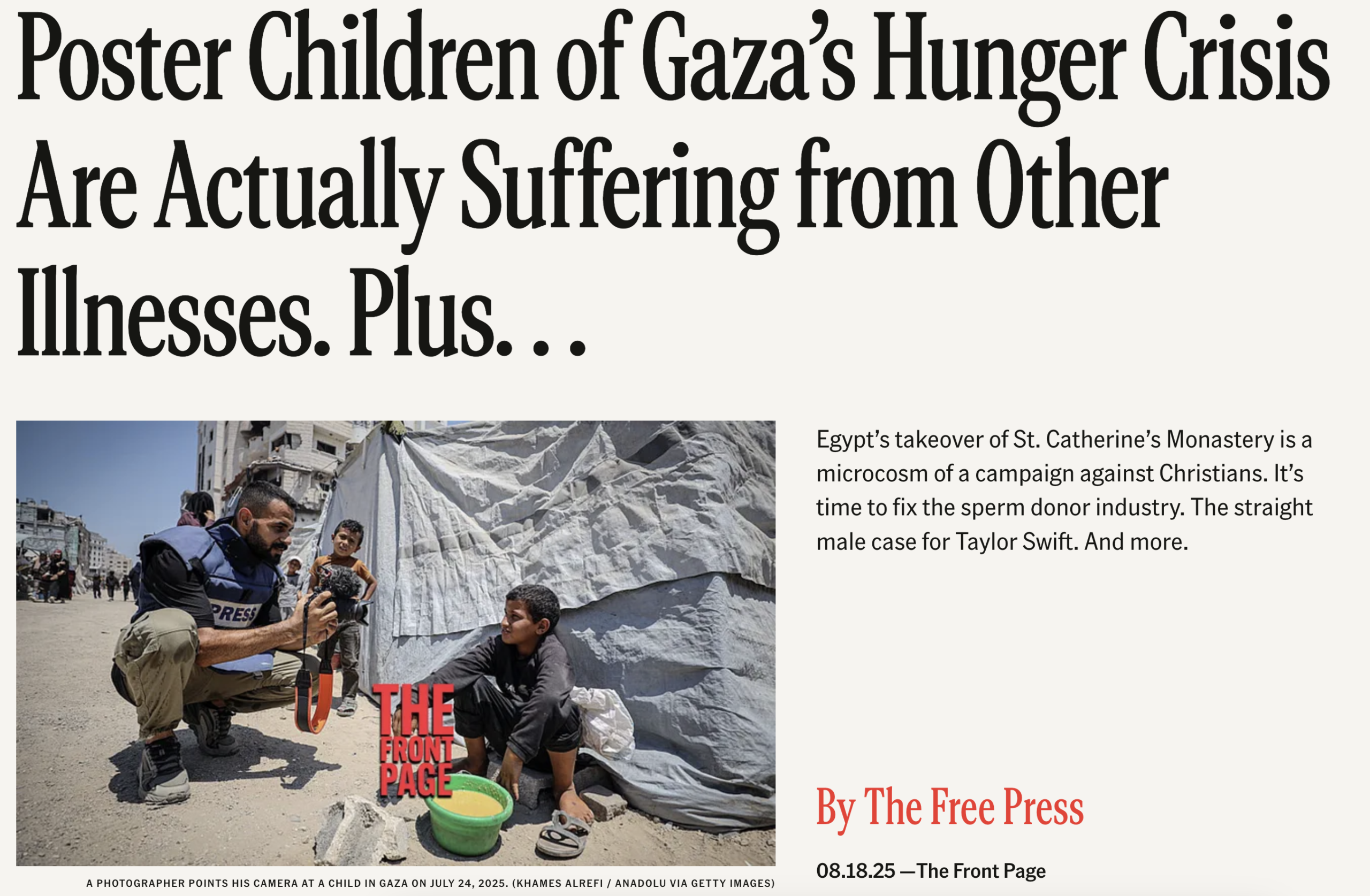
Zionist publications like The Free Press, which published apologia belittling the starvation of Palestinian children in Gaza (because some of them had preexisting conditions, which actually makes them more vulnerable), pretend they’re concerned about human rights in Iran and dare to lecture about the world watching idly by.
It is almost beside the point to say that Zionists are hypocritical in their fake tears for Iranians because they have spent the last two-plus years supporting genocide and continue to evince the most callous indifference (if not support) toward the ongoing daily violence against Palestinians, including pogroms in the West Bank.
The hypocrisy is the point: It reflects the sense of power Zionists believe they wield to enforce their narrative — contradictions be damned! — over the American public. But it also reflects their growing sense of isolation: Their lack of self-awareness and earnest mendacity can only be maintained in a bubble.
Let us be clear: Zionists do not care about the well-being of Iranians fighting for democracy. When Zionists post in support of Iranians against their regime, they are not engaged in solidarity but in predatory behavior. Solidarity is supporting someone struggling for their rights; predatory behavior is when your support is opportunistic because you think you’ll benefit.
It should hardly need mentioning, but there was no mainstream Israeli solidarity with Egyptians, Tunisians, and other Arabs fighting against their tyrannical regimes during the so-called Arab Spring.
Instead, Israelis expressed, at best, deep apprehension about the downfall of pro-Israel regimes and the empowerment of pro-Palestine Arabs citizens. The world of Zionists is one of communal narcissism, where every event is assessed by the metric: Is this good or bad for Israel?
Since Arab regimes, like Egypt’s Mubarak, were aligned with U.S. imperial goals, of which impunity for Israel is paramount, Israelis feared the downfall of Mubarak more than they welcomed a democratic Egypt.
Similarly, it is very unlikely that if, say, Israelis were to witness a mass popular uprising in the United Arab Emirates — which is strongly aligned with Israel, even though 80% of the population opposes the normalization deal — they would rush to celebrate Emiratis and document their repression. Instead, they would most certainly mimic the regime’s demonization of the demonstrators as terrorists and encourage the Israeli government to send planeloads of bullets and tear gas to Abu Dhabi.
The fact is, Israelis are perpetually worried about their position in the region — a natural state concern, of course, but Israel’s worry is unique. Israeli worry is not existential since Israel knows it is the military superpower in the region and the only state that holds nuclear weapons.
Instead, it is any anxiety about regional dominance: Whether Israel can continue to operate with total impunity. A state at peace with the Palestinians, a state that willingly accepts equality between itself and its neighbors, would have had no reason to worry about the Arab Spring.

Israelis worried about how the end of the Cold War, for example, would affect them because Israeli strategy was dependent on demonizing the Palestinians as Soviet allies. Without the Soviets, Israel worried that its opposition to Palestinian self-determination would have less purchase amongst American policymakers.
In the same vein, Zionists’ feigned concern for Iranians is a political calculation that the end of the ayatollah’s rule would lead to a new era of Persian-Jewish cooperation, one that Israel could parlay to further aggrandize its regional power and sideline Palestinian aspirations for self-determination. In other words, Zionists pretend to cheer on Iranian self-determination only so they can more easily prevent Palestinian self-determination.
But this begs the question: Why do Zionists assume that whatever replaces the current regime would be pro-Israel?
Zionists base this assumption on the fanatic subservience exhibited by the self-styled Shah-in-exile of Iran (the son of the late, deposed Shah) and the sentiments expressed by extremely anti-Muslim, anti-Arab, “Ayran”-identifying, right-wing Iranian nationalists. Zionists assume these forces will take power,
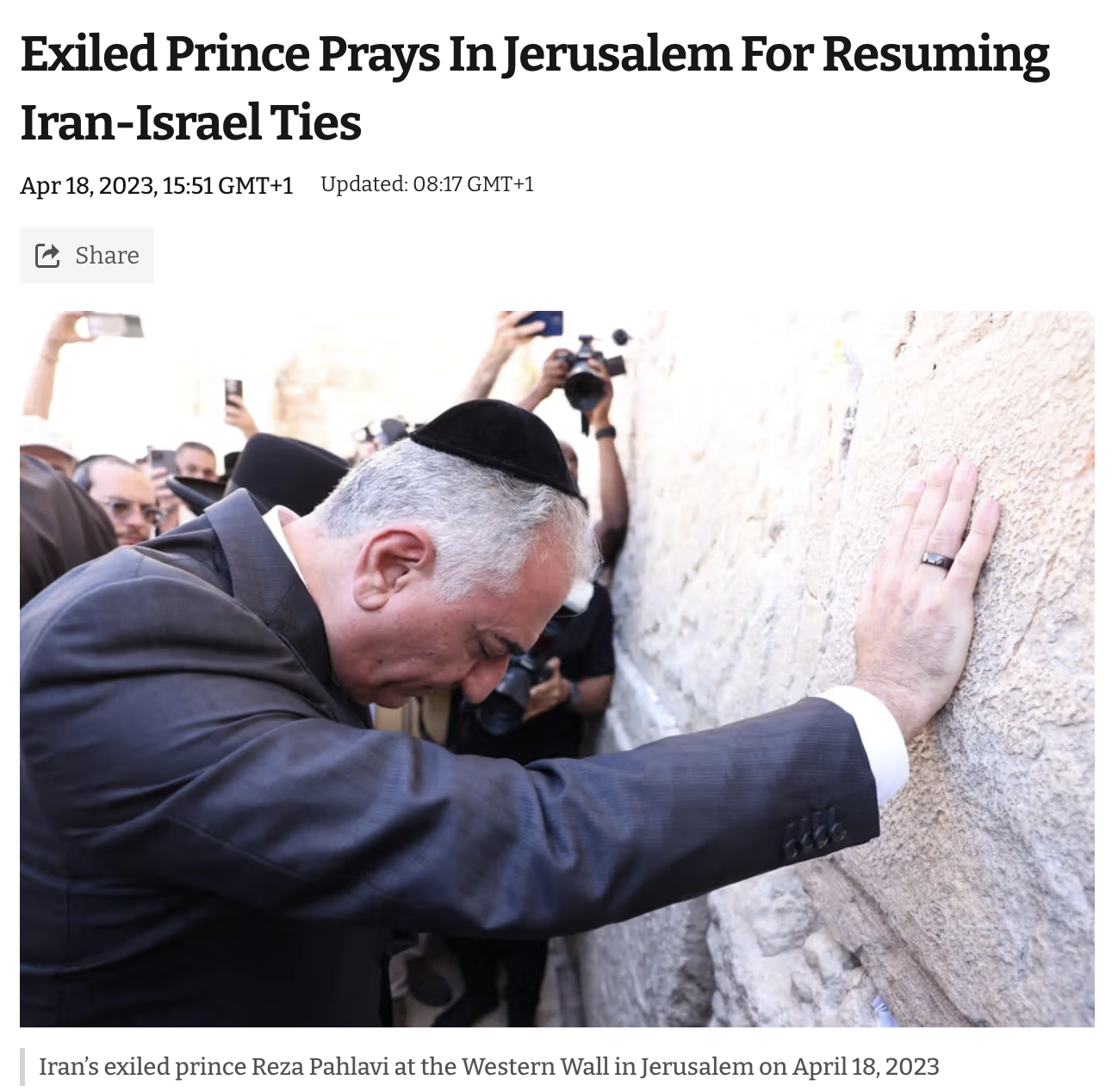
The Iranian right-wing harbors a deep entitlement to power, but as Iraqi exiles who similarly courted Zionists found out after the fall of Saddam Hussein: People who have lived under the boots of tyrants hardly wish to be ruled by individuals who did not share in their fate, but spent the last several decades living in Los Angeles. (
The notion that Israel can help Iranian exiles more than it could help Iraqi ones is an antisemitism fantasy about Jewish power in Washington; one that Israel is actually happy to encourage since it encourages a deferential posture toward it.)
Munther al-Fadhal believes that there is no place for religion in a new constitution for Iraq. He favors the establishment of relations between Iraq and Israel.
The obvious fact is that no one can predict what would happen in a post-Islamic Republic Iran. And Israel’s real intentions are hardly noble.
As Iran expert Trita Parsi has noted, Israel fears a strong Iran, whether it is aligned with or against. Israel knows from experience, as Parsi has related, citing the words of an Israeli official, that a friendly Iran (such as the one that existed under the Shah) can one day turn hostile; this has happened before, and can happen again.
So Israel does not want to risk the prospect of a strong Iran that could turn against it again. The Israeli hope is for a chaotic post-regime transition that could see Iran split apart through Israel’s promotion of separatist movements in the north and south.
Such an idea has already been marketed by the ultra-Zionist Wall Street Journal editorial page:

And if that day passes, the very same Zionists whose hearts ostensibly cry out for suffering Iranians would back Israel’s mischief-making to the hilt. Suddenly, they would be such sincere champions of Kurdish secessionism and even back the Arabs in the south of Iran.
This isn’t mere speculation since we can see this Israeli strategy at play in Syria right now. The downfall of the Assad regime, and the fact that the new regime has made peace overtures to Israel (even willing to relinquish claims on the Golan Heights), has done nothing to restrain Israel from stirring up sectarian animosity between the new Sunni regime and the Druze in the south of the country.
The ploy here is to undermine the reconstruction of Syria and keep the nation bogged down in violence, chaos, and division.
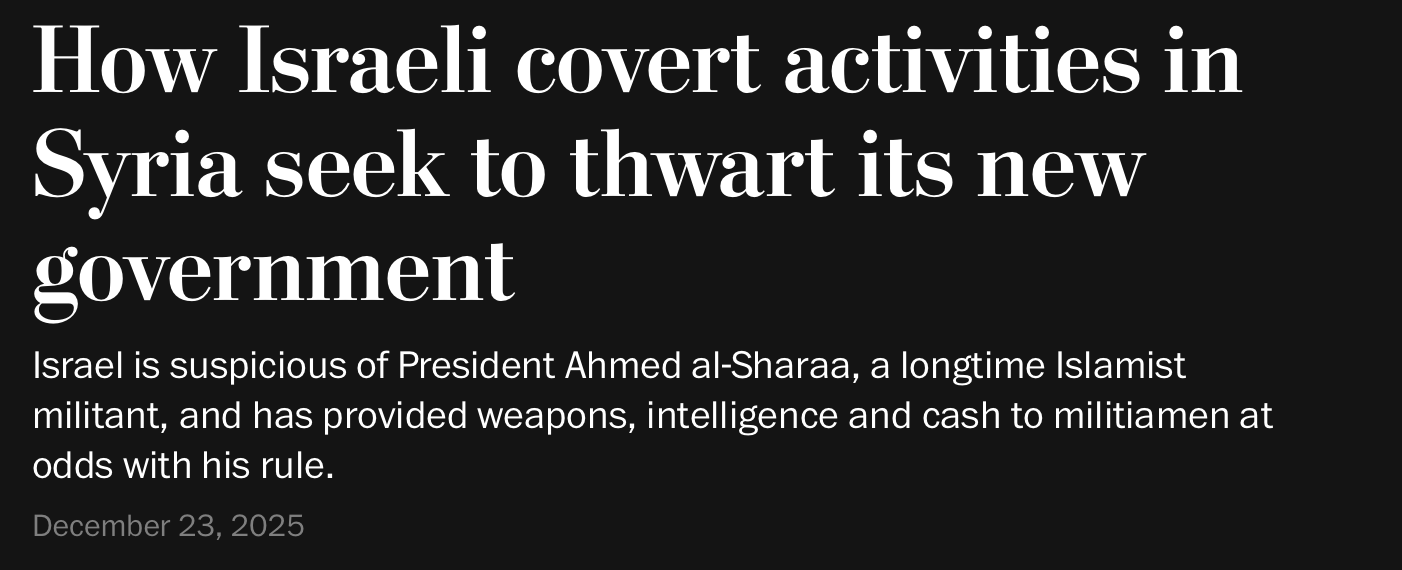
Zionists, very much the sycophantic devotees of whatever Israel does, have parroted phony expressions of solidarity with the Syrian Druze and pretended as if Israel is defending minority rights in Syria.
Where were these Zionists when the Druze minority inside Israel protested against the Jewish supremacist Nation-State Law and demanded equality? They were attacked by the very Israeli ministers know pretending to care about Druze in Syria. Of course, Zionists could hardly care about Druze in Israel or Syria or anywhere; it is merely predatory: using another people for one’s oppressive ends.