

As AIPAC comes under more and more scrutiny, Zionists are pushing back on the accusation that the Israel lobby exercises major influence over U.S. policy in the Middle East. Some Zionists have even taken to conflating AIPAC with the American Jewish community writ large and claiming that the alleged demonization of the lobby is an attempt to expel Jewish Americans from the public square.
It is an accusation that is a mischaracterization — conflating Jews with AIPAC — and rich with irony: Pro-Israel partisans have for decades used their influence and status to exclude Palestinian Americans and their supporters from having a say on policies that adversely impact the well-being of Palestinians.
Let us establish some basic parameters. There is nothing that AIPAC does that is outside the normal conduct of a lobby group. AIPAC is not some shadowy cabal; it is a legal operation with an office building in DC. Efforts to portray AIPAC as an all-powerful hand behind the scenes are inaccurate and could lead to potentially antisemitic distortions of how an outside lobby group influences U.S. policy on Israel.
Moreover, the pro-Israel Congressional consensus that AIPAC has shaped is no different from that of, say, a Wall Street lobby group. The disconnect between the political class’s policies and public opinion is all too common in the American body politic due to the enormous weight of money in political campaigns, where the interests of big donors have come to outweigh the preferences of ordinary voters.
But just as it is reasonable and necessary to scrutinize how, say, the pharmaceutical lobby influences public policy, it is fair to do the same with AIPAC. Efforts to shield political power from criticism by wrapping oneself in the moral capital of victimhood via bad-faith accusations of antisemitism are cynical and risible.
So let us study the role AIPAC plays in pushing for pro-Israel policies and establishing parameters of conduct — the latter is often forgotten. A lobby might not always get what it wants, but even when it fails to achieve its maximalist goals, it can still be successful in ensuring that only a narrow range of policies are approved by Congress or pursued by the White House. In other words, a lobby works both to achieve positive policies and foreclose negative policies, as judged by its interests.
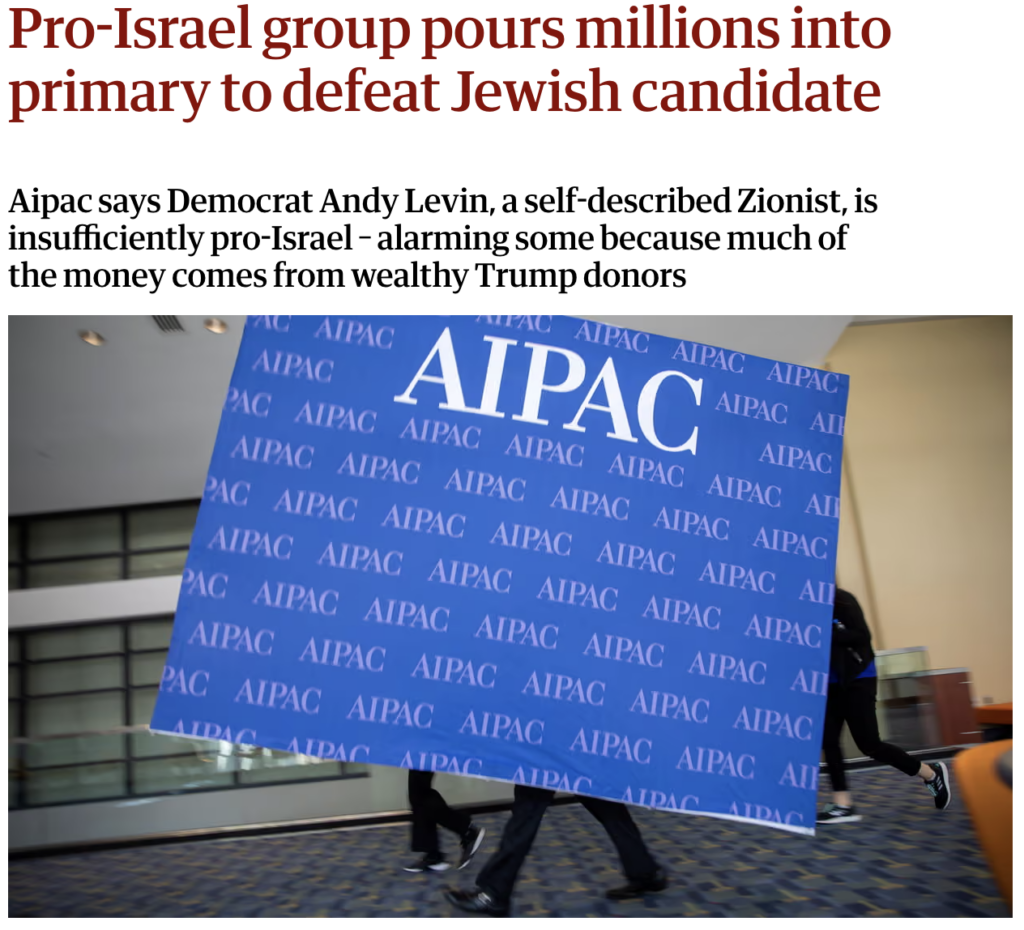
One major metric of influence is campaign donations. Money buys power in DC. AIPAC certainly believes so. After going decades without a Super PAC, AIPAC created a deep-pocketed campaign fund in response to growing Congressional opposition to Israel. Established in 2022, the United Democracy Project started targeting candidates that year, including spending $4 million — more than both candidates combined — to defeat a Jewish member of Congress.
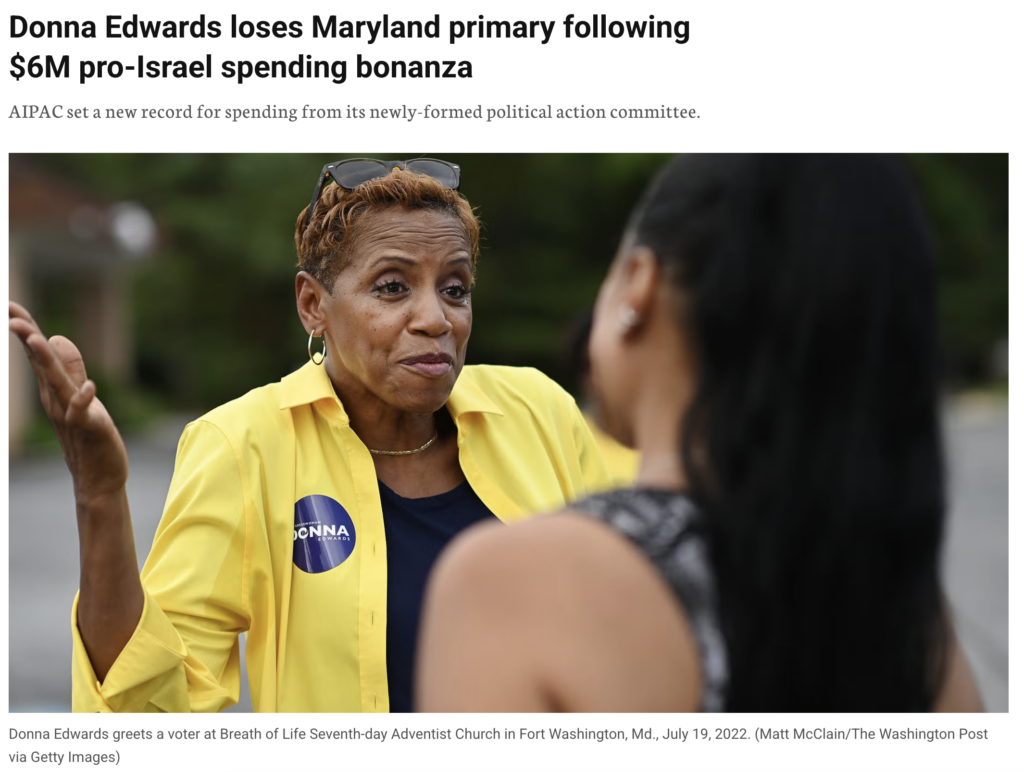
AIPAC achieved another win by outspending a five-term Congresswoman:
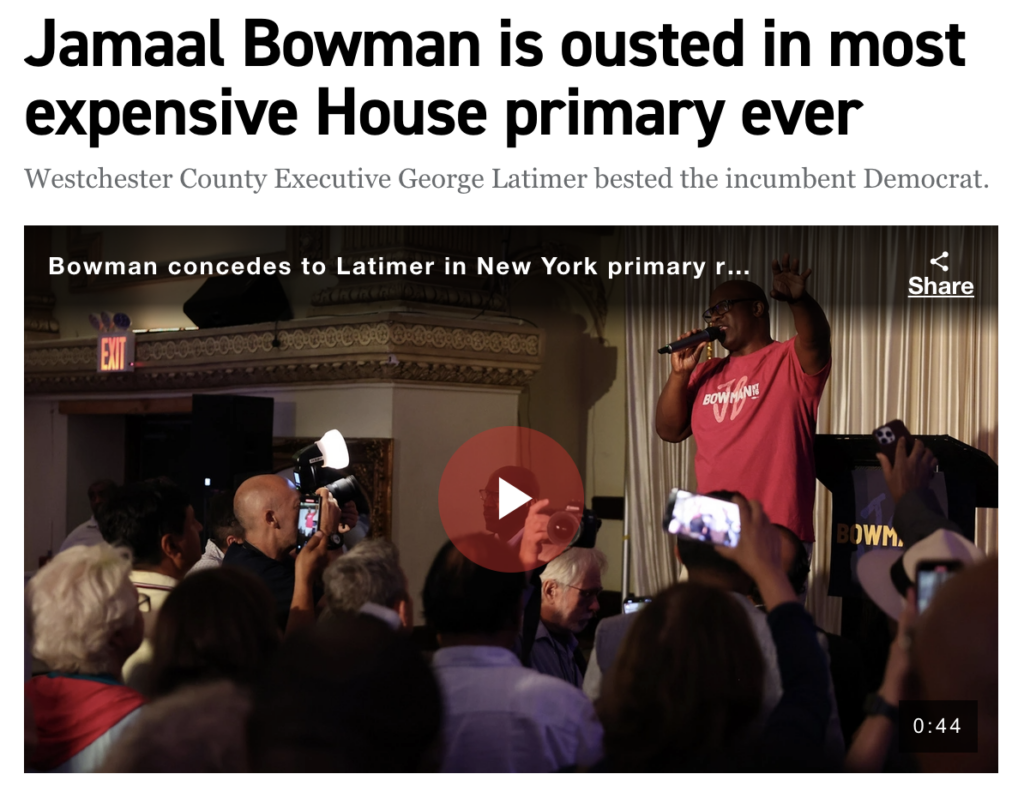
2022 was a dry run for the next round. In 2024, AIPAC turned a campaign against an incumbent pro-Palestinian Congressman into the most expensive Congressional race in history due to $14 million worth of attack ads.
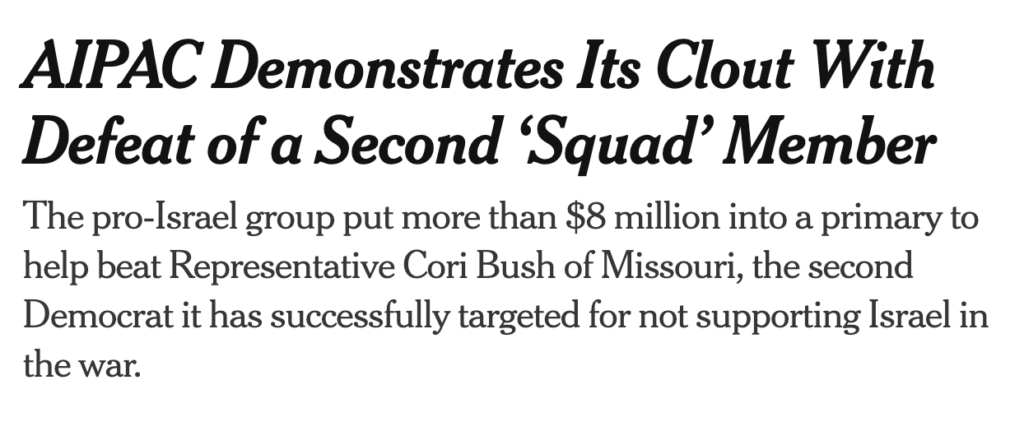
AIPAC followed up by defeating another incumbent Congresswoman in St. Louis by throwing $8 million into the race:
 In total, “AIPAC’s PAC and UDP spent nearly $126.9 million combined during the 2023-2024 election cycle, according to the FEC.
AIPAC’s campaign donations work both ways: defeat candidates and shore up support. AIPAC will donate to incumbents and candidates as a legalized bribe to ensure they toe the party line. This is the source of the disconnect dividing a political class from its own party base. Democratic voters are overwhelmingly pro-Palestinian, believe (rightly) that Israel is an apartheid state that has committed genocide in Gaza, and less than 10% of Democrats want U.S. policy to favor Israel over the Palestinians.
But the leadership of the party in Congress and most of its elected members continue to parrot AIPAC’s pro-Israel talking points. What gives? Literally, AIPAC forking over cash to countless campaign funds. This is the general problem of a politics more responsive to major donors than to its own constituents.
Take a look at the Democrats’ House leadership. Rep. Hakeen Jeffries, in line to be Speaker of the House if the party flips the House, counts AIPAC as his top donor: 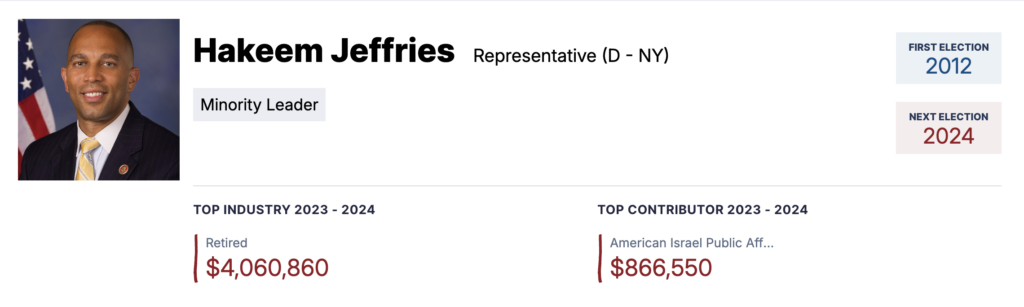
Rep. Jeffries is not alone. In fact, four of the five Democratic leaders in the House count AIPAC as their top donor, according to OpenSecrets, which tracks money in U.S. politics. Moreover, the Ranking Member on the House Foreign Affairs Committee, Democratic Rep. Gregory Meeks, who would become committee chairman if the party takes back the House this fall, also counts AIPAC as his top donor.
AIPAC does not hand out cheques, and its donors do not part with tens of millions of dollars, because they do not believe that their donations make a difference. So, yes, AIPAC does wield real power on Capitol Hill — a Democratic Party more partial to its rank and file voters would have little incentive to be slavishly pro-Israel without a monetary inducement.
This is a fact that is a reality of American politics that goes beyond AIPAC. Pretending that lobbying makes a difference on, say, gun control or tax cuts for the billionaire class, but somehow not when it comes to U.S. policy on Israel, is a joke beyond sickness. AIPAC would not need to exist if Congress were merely pro-Israel out of habit.
While it is true that genuine pro-Israel sentiment is common in the United States, lobbies exist to parlay a favorable context (until recently, American public opinion was pro-Israel) into more maximalist policies that public opinion alone would be insufficient to deliver.
Gun culture is widespread in the country, but the NRA’s achievement has been to capitalize on general support for gun ownership to achieve policy goals that are actually misaligned with public opinion.
Most Americans, including most gun owners, support background checks and an assault rifle ban, but the NRA has blocked such measures. Similarly, even when U.S. public opinion was broadly pro-Israel, most Americans supported cutting off military aid to Israel if the country refused to end illegal settlement construction. A lobby exists to block off popular policies while foregrounding itself in a more nebulous sentiment that is generally pro-gun or pro-Israel. Up to a point, this contradictory policy can work.
Right now, countless pro-Israel Democrats are decrying the settler terrorism against Palestinians in the occupied West Bank. This is rooted not in heartfelt sympathy for Palestinians, but in an attempt to thread the needle; it is more about optics than actually changing Israeli policy, which would require imposing costs on Israel that most elected Democrats are loath to do.
“Israel’s backers in the United States, especially among liberals and Democrats, understand how much of a political liability supporting Israel has become,” said Yousef Munayyer, head of the Palestine/Israel program at Arab Center DC.
He added that politicians backed by pro-Israel donors but facing an increasingly pro-Palestinian electorate are “trapped between the money they’ve relied on to make their campaigns work and the voters they actually need to win”.
He believes that condemning blatant settler violence is an easy way for them to express some discontent with Israel without rattling donors. “It ostensibly offers these Democrats a way to condemn the actions of Israelis against Palestinians without challenging the Israeli state itself.”
